


Understanding AI-powered homes, this article explores insights from two international experts, who shed light on the future of smart living, focusing on interoperability standards and the seamless integration of intelligent systems that make homes truly adaptive and responsive.
In a world where AI curates our content and predicts our routes, it was only a matter of time before it became an essential part of our homes. Home automation has entered its most transformative phase, where, from app-controlled lighting and voice-activated appliances to AI-powered environments that learn from their occupants, anticipate needs, and respond intelligently to both human behavior and architectural context. For technology enthusiasts and design professionals alike, this signals a decisive shift: homes are no longer static shells fitted with smart gadgets, but adaptive, intelligent systems seamlessly woven into the built environment itself.
An AI-driven home goes far beyond preset schedules, dynamically responding to real-life patterns of use. Thermal zoning adjusts automatically based on actual occupancy rather than fixed timelines, while lighting systems learn and adapt to preferred colour temperatures for work, leisure, or rest. At the same time, energy consumption is intelligently analysed to predict peak usage and optimise electrical loads in advance. This shift from rule-based automation to learning-driven adaptation is particularly compelling for tech enthusiasts, as it signals AI’s evolution from reactive control to true anticipatory intelligence, a defining trait of next-generation computing systems.
Understanding AI-Powered Homes for Professionals
For architects and designers, AI-powered homes introduce an entirely new design dimension where the context-aware space responds intuitively to human presence and environmental conditions. Automation is no longer a layer added post-design; it is embedded into spatial planning, material selection, and the very logic of how a home functions. These intelligent systems read who is in a space and for how long, interpret activities such as working, entertaining, relaxing, or sleeping, and respond to environmental factors including natural light, acoustics, air quality, and external climate.

As a result, spaces become fluid rather than fixed. A living room can transition effortlessly from a daylight-filled social zone to a subdued, immersive entertainment setting, while bedrooms dynamically adjust lighting spectra to support healthy circadian rhythms. Architecture, in this context, becomes dynamic, capable of transforming through intelligence rather than physical modification.
The rise of AI-powered homes is also reshaping collaboration between architects, interior designers, and technology integrators. Design decisions now account for discreet sensor placement, acoustic optimisation for voice and sound recognition, material choices that enhance thermal and lighting intelligence, and spatial layouts designed for zoning and personalised experiences. This convergence fosters a holistic approach in which technology quietly amplifies design intent instead of disrupting it. Minimalist interiors, in particular, benefit from hidden automation and AI-driven scenes that preserve visual clarity while delivering high-performance living environments.
Smart Home World speaks with two international experts to explore the future of AI-powered homes, delving into interoperability standards and the opportunities that lie ahead.
Tobin Richardson, Connectivity Standards Alliance President and CEO

How will interoperability standards like Matter accelerate AI-powered, context-aware home automation?
The current conversation around smart home and AI use cases is rapidly evolving, shaped by consumer demand, the prevalence of sensors in the home, and the growing impact of generative AI solutions by major tech platforms. AI can mediate between devices across different brands, learning how to create unified routines despite protocol differences.
In order for this to happen, these devices need to be able to communicate with each other and share data seamlessly. This is where Matter comes in. It provides a common language across devices, to make it easier for a complete picture of the home — across energy usage, sensors, apps, appliances, media devices, lighting, door locks, controllers, and more. With Matter adoption expanding, smart homes are now more cross-compatible and AI is gaining a powerful superset of data that can be used to make smarter, predictive and more personalized experiences a reality.

What role will AI play in enabling devices from different brands to work together intelligently?
AI-driven ambient experiences and voice control in smart homes are advancing, especially following a number of major initiatives in 2025 from Google with Gemini Home, Amazon with Alexa Plus, Samsung AI Home, and Apple Intelligence. These efforts have put a big spotlight on the potential of AI in people’s homes, elevating the priority to get the foundational elements needed for these models to learn right.
At a basic level, smart devices first need to be powered on, connected, able to interact meaningfully, and work reliably together. Matter plays a key foundational role by enabling devices to communicate and understand each other. This data is then able to be used and trained on by the language models to help move the smart home beyond simple, rule-based actions to more intelligent and automatic experiences operating in the background.
Where do you see the biggest opportunities for AI in residential spaces over the next 3–5 years?
We are just at the beginning when it comes to the impact that AI can have, not just on residential spaces, but multi-family as well. The models still need to be trained, so we’ll see simple use cases to start, which can still have a powerful impact on how people live and interact with their home. As more devices come to market with Matter, and as these models learn and adapt, AI will be layered into every smart home controller, ecosystem, utility, or property management system, allowing it to do things like:
Automate energy consumption, adapting to the individual’s needs from an efficiency or cost savings standpoint, or those of the energy grid.
Make more intelligent decisions based on sensor-driven points through the home, such as occupancy, movement, and usage patterns, making life simpler, safer, and more efficient – which could have a big impact on health and aging in place. This will enable a powerful new layer of smart notifications too.
Anticipate problems and schedule maintenance to ensure small issues don’t turn into big ones and that products can last longer in the home, creating less e-waste.
Allow multi-family building owners and managers to more smartly deploy and manage smart devices and energy management across hundreds of units, while creating new value adds to residents.
Internet service providers will be able to more intelligently manage hundreds of devices on a homeowner’s network, adapting to bandwidth needs and usage patterns, and ensuring the most critical devices are always working.

Looking ahead to 2026 and beyond, the priority for companies remains ensuring strong performance on the fundamentals—such as device quality, reliable connections, low latency, and support for many devices on a network—because advanced AI experiences will depend heavily on these core capabilities. The Alliance and our members will be active participants in this effort, as it will take continued hard work to ensure the potential of AI in smart homes and buildings is realized.
Avi Rosenthal, Chairman of the Board, Z-Wave Alliance& Managing Partner, BlueConnect Partners

How will Z-Wave technology accelerate AI-powered, context-aware home automation?
AI-powered home automation only works when devices can reliably discover each other, share context, communicate effectively, and behave consistently across brands. This is one area where Z-Wave technology has already demonstrated real-world success for the past 20 years. In homes with dozens of connected devices, AI depends on standardized communication, clear device identification and enrollment, as well as dependable interoperability in order to properly recognize patterns, apply rules and continuously optimize behavior.
Z-Wave’s mature ecosystem of certified products enables a diverse range of devices to connect seamlessly, permitting AI to operate at the application layer rather than being bogged down by integration challenges. When devices work harmoniously together, AI can focus on higher-value tasks like learning occupancy patterns, optimizing energy usage, and coordinating responses across lighting, climate, smart plugs, and so much more. This foundation is what makes scalable context-aware automation possible.
What role will AI play in enabling devices from different brands to work together intelligently?
AI has the potential to provide an intelligence layer that begins to turn interoperability into coordinated action. For example, by using machine learning to map inconsistent device labels in shared frameworks, AI could lead to products from different manufacturers to “speak the same language” and collaborate in more meaningful ways than they already do.
Perhaps most notably, AI enables devices to begin sharing a critical piece of information: context. By allowing occupancy data from lighting sensors (for example) to inform HVAC behavior or help smart plugs determine which devices truly need power, coordinated actions across these systems can compound efficiency gains. Over time, these micro interventions have a measurable impact.
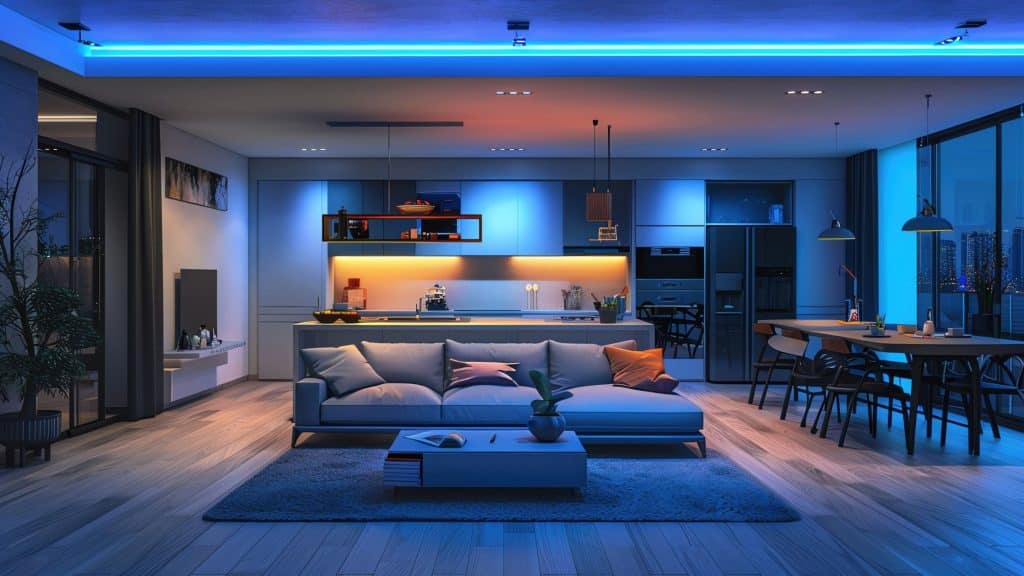
Furthermore, the integration of conversational AI interfaces can make these interactions more transparent. Users can ask why something within their home happened, receive a clear explanation, and, importantly, override the behavior when needed. This transparency can help build trust, further establishing multi-brand or multi-protocol automation as helpful and supportive, rather than being intrusive or complicated.
Where do you see the biggest opportunities for AI in residential spaces over the next 3–5 years?
One of the most significant opportunities is predictive energy management that delivers measurable efficiency gains without sacrificing comfort. Intelligent automation has already been shown to reduce device power draw by 25% or more, simply by eliminating wasted energy from everyday appliances like TVs, printers, and coffee makers. In HVAC systems, data-driven control using variables such as occupancy, weather, and humidity has demonstrated efficiency improvements of around 16% compared to traditional rule-based approaches, all with no noticeable impact on comfort.
Looking ahead, AI will increasingly anticipate needs rather than react to them. Homes will pre-adjust based on weather forecasts, historic occupancy patterns, and user preferences such as pre-cooling ahead of a heat wave to avoid peak demand. Reinforcement learning will continuously refine these behaviors based on how residents interact with their homes.
Equally important is the shift toward local, privacy-preserving AI that remains responsive even when cloud connectivity is unavailable. As homes become more intelligent and interoperable, they will also become active participants in a more resilient energy ecosystem, further supporting grid stability, renewable integration, and sustainability goals.
In conclusion, we would say, in the Indian context, how these technologies will ultimately be received remains to be seen. While there is growing interest in smart and AI-led living among urban and premium homebuyers, factors such as price sensitivity, digital literacy, reliability of infrastructure, and cultural attitudes towards privacy and automation will play a decisive role. The success of AI-powered homes in India will therefore depend not just on technological advancement, but on how well these solutions are localised, simplified, and aligned with the everyday realities of Indian households.