
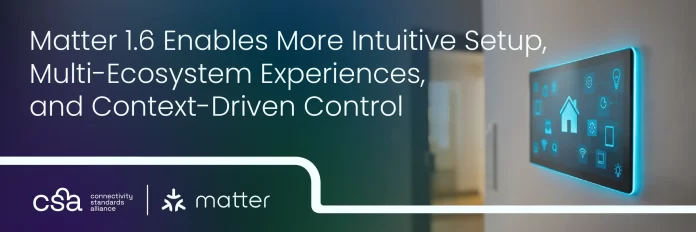
The Connectivity Standards Alliance has announced the release of Matter 1.6, now available for device makers and platforms to integrate into their products. Matter 1.6 is a focused feature release offering device makers, ecosystems, and platform developers new tools to build smarter, more flexible smart home experiences. Rather than expanding into new device categories, this release enhances device setup, improves how ecosystems can coordinate device management, and refines how devices interpret and respond to control inputs to better reflect user preferences and context. Core enhancements also improve how devices communicate their capabilities, operational states, and safety information across ecosystems.
NFC-Based Commissioning: Setup Designed for Real-World Use
For many smart home devices, installation and commissioning do not occur simultaneously, and commissioning can be challenging. Ceiling fixtures, in-wall switches, and other installed products often need to be configured before final installation due to awkward placement requirements, creating additional complexity during deployment. Matter 1.6 introduces NFC-Based Commissioning, addressing this need by allowing a Matter device to be commissioned through bi-directional NFC communication, even before the device is fully powered on.
This builds on the NFC onboarding payload support introduced in Matter 1.4.1, which embedded setup information in an NFC tag as a more convenient alternative to scanning a QR code, but still relied on Bluetooth LE to complete commissioning. Matter 1.6 goes further: the full commissioning exchange can now happen over NFC, making it a genuine alternative to BLE-based setups.
In practice, this means a light bulb can be commissioned before it is screwed into a ceiling fixture, and an in-wall switch can be set up before mains power is on. For larger installations, multiple devices can be provisioned in advance and activated at their final locations. For end users, the experience is immediate and tactile: simply hold a phone near the device to commission it.
Joint Fabric Adds a New Path for Multi-Ecosystem Device Sharing
Matter 1.4 introduced Enhanced Multi-Admin, which gave ecosystems tools to automate the sharing of device access across platforms with a single user consent. Matter 1.6 further expands the Multi-Admin toolkit with Joint Fabric, offering a new and distinct approach that works differently from previously introduced methods.
Where earlier Enhanced Multi-Admin approaches share device access between separate ecosystem networks, or “Fabrics,” Joint Fabric allows multiple user-authorised controllers to co-administer a single shared Matter network. Utilising a central Datastore, any device added to the Joint Fabric is accessible to all participating controllers. Administrators can be added or removed independently of the devices on the network, and participation in a Joint Fabric counts as a single fabric toward a device’s capacity, leaving room for it to also participate in traditional ecosystem Fabrics simultaneously.
Joint Fabric is well-suited to environments where multiple parties need coordinated access to the same devices, new construction handovers, households running multiple platforms, or professionally managed properties. For end users, it means devices can appear and be controlled from whichever ecosystem or interface is most convenient to them, without requiring separate setup in each one. For ecosystems and developers, it provides a standardised foundation for these multi-admin scenarios without relying on proprietary approaches.
Thermostat Suggestions: Smarter Comfort Aligned with User Preferences
Today, smart home ecosystems send commands directly to thermostats, which may act on them without much context, executing whatever instruction arrives, regardless of the user’s recent inputs or preferences. Matter 1.6 introduces Thermostat Suggestions, which alter this dynamic by giving ecosystems a standardised way to transmit recommended changes and thermostats a standardised way to evaluate them against user-defined preferences with current context before acting.
Rather than a controller sending a direct command to change temperature or mode, it submits a time-bound suggestion tied to one of the thermostat’s supported presets. The thermostat then reacts accordingly based on preferences and current environmental conditions. A few examples include:
- A user enrolled in a utility demand-response program can configure the thermostat to protect those commitments, preventing an automation from a different ecosystem from accidentally overriding a savings event.
- A user who has chosen to optimise for energy savings, or for humidity control, air quality, or another preference, can have the setting recognised and respected across connected services without needing to configure it in each one.
- A thermostat that was just manually adjusted, on the device or through one ecosystem, can recognise a suggestion arriving moments later from another source and will identify it is likely not what the user intended, and defer.
When a suggestion is not followed, the thermostat provides a standardised explanation, providing both users and ecosystems clearer visibility into its behaviour. The result is a more intelligent and predictable thermostat, balancing recommendations from connected services while remaining aligned with user instructions and preferences.
Core Enhancements
Matter 1.6 brings targeted refinements to device status communication and ecosystem security, improving visibility and trust across connected environments.
Device Capability and Limits Communication. Devices can now communicate their capabilities and operational limits in a standardised way, allowing controllers to represent and use devices more accurately across ecosystems.
Security Sensor Event History. Security sensors can interoperably indicate sensor event history, giving ecosystems access to real-time status and past activity. This enhancement supports more informed security experiences by providing greater context around when events occur.
Unmounted State for Smoke and CO Alarms. Alarms are now able to indicate when they have been removed from their installed position, giving ecosystems and users a more accurate picture of whether a device is operational.
Partitioned Certificate Revocation Lists. Building on CRL support from Matter 1.4.2, revocation information can now be managed in smaller, independently updated partitions rather than a single large set, making the security infrastructure more scalable as the number of certified devices grows.