
What makes an automation platform the true “brain” of a smart home? Smart Home World explores the key factors that define a robust platform, from integration and reliability to user experience, security, scalability and AI, with insights from leading industry experts.
A smart home can have the best lighting, sophisticated AV, advanced security, intelligent climate control and an impressive array of connected devices, and still fall short of being truly intelligent. The difference lies in what happens between them: how these systems communicate, respond and work together as a cohesive whole.
As residential automation becomes more sophisticated, choosing a platform is no longer simply about comparing features, processing power or the number of devices it can control.
The real challenge is finding an architecture that can bring different systems together, respond intuitively to the homeowner’s needs, remain reliable as the project evolves and protect the data running quietly behind the scenes.
That makes the “brain” of the home one of the most important decisions in any automation project.
But what exactly qualifies as the brain? Is it the processor, the software, the interface or the larger architecture connecting everything? And how should homeowners, designers and system integrators determine which platform is right for a particular project?
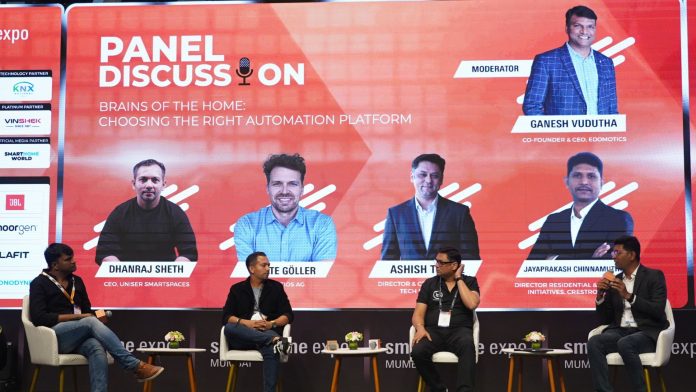
These questions took centre stage at the panel discussion “Brains of the Home: Choosing the Right Automation Platform” at Smart Home Expo 2026. Moderated by Ganesh Vudutha, Co-Founder & CEO, Edomotics Smart Systems, the discussion brought together Dhanraj Sheth, CEO, Uniser SmartSpaces; Ashish Tijare, Director & CEO, Intelligible Tech Solutions Pvt. Ltd.; and Jayaprakash Chinnamuthu, Director of Residential & Strategic Initiatives, Crestron Electronics India.
Rather than focusing only on processors and control interfaces, the panel examined the larger architecture behind a successful smart home, from platform selection and interoperability to scalability, AI, cloud connectivity, privacy and the increasingly important role of the professional system integrator.
IT’S NOT JUST THE PROCESSOR
The first misconception the panel challenged was that the “brain” of a smart home can be reduced to a single piece of hardware.
In reality, the intelligence of an automation system comes from the way its hardware, software, programming, communication protocols and user interfaces work together. Lighting, HVAC, motorised shades, security, AV, access control and other systems may operate on different architectures, but the homeowner should experience them as one connected environment.
Dhanraj Sheth, CEO, Uniser SmartSpaces, put the emphasis firmly on the experience rather than the hardware. “The brain of the home or the brain of the automation system is something that can seamlessly communicate across multiple brands, multiple devices and multiple protocols.”
For him, the automation system should ultimately be judged by the experience it delivers rather than by the individual piece of hardware sitting at its core.
Jayaprakash Chinnamuthu, Director of Residential & Strategic Initiatives, Crestron Electronics India, offered a similar analogy, describing “the brain as the central controller that communicates with the different parts of the home—much like the human brain coordinates the body’s limbs, eyes and ears. The implication is important: the brain is less about what the device is and more about what the overall architecture enables it to do.”
He further adds, “A platform may control hundreds of devices, but if those devices operate as isolated islands, the home is not necessarily intelligent. True automation comes from creating meaningful relationships between systems—so that lighting can respond to occupancy, shades can work with daylight conditions, climate control can respond to routines and entertainment can become part of a larger scene rather than a standalone function.”
START WITH THE HOMEOWNER, NOT THE BRAND
If the brain is responsible for bringing the home together, the next question is how to choose it.
The panel’s answer was clear: begin with the requirement, not the product.
Homeowners often approach automation projects with a predetermined list of brands or products; one for lighting, another for shades, another for AV and another for climate control. But choosing individual products first can make integration considerably more complicated.
Instead, the starting point should be the desired experience.
“In fact, whenever we are getting a space done, the first thing we need to do is get a professional system integrator on board who can help understand what the user’s experience wants to be, and then peg it to what system would best be able to support that,” said Chinnamuthu.
This approach shifts the conversation from a shopping list of devices to a discussion about how the home should actually function. Does the homeowner want centralised control? Seamless scenes? Voice interaction? Greater energy management? Sophisticated entertainment? Enhanced security? Or simply a home that quietly responds to everyday routines?
The answers can influence everything from the platform and communication protocols to the network architecture and user interface.
Ashish Tijare added another perspective, highlighting the importance of support and technical resources for integrators.
“All systems and manufacturers are good, but it all depends upon which segment you are addressing. For system integrators, however, there are additional considerations. One is the level of support available from the manufacturer. A good automation platform should allow integrators to educate themselves, troubleshoot problems and resolve issues without being completely dependent on the manufacturer.” Online courses, comprehensive documentation, technical resources and training programmes therefore become important criteria. “If you go to Crestron or Savant’s website, you have documentation to guide you through. If you are stuck at the site, you should be able to troubleshoot yourself. You should be able to resolve the problem yourself. Only then, in my opinion, is a good system to be taken forward to your project.”
For a professional installation, the strength of the ecosystem around a platform can therefore be just as important as its headline specifications.
THREE THINGS THAT MATTER MOST
For homeowners, the panel distilled platform selection into three fundamentals: reliability, scalability and security.
Reliability is perhaps the least visible but most important. Automation becomes infrastructure once it is embedded into everyday life. Lighting scenes, climate control, access, security and entertainment are expected to work consistently without requiring constant intervention. A smart home that occasionally fails to respond can quickly undermine the very convenience it was designed to provide. Reliability therefore extends beyond individual devices to the network, software, programming and communication between systems.
Then comes scalability.
A home rarely remains static. New rooms, devices, lighting loads, security systems or AV zones may be added over time. A platform that works for today’s requirements but becomes restrictive tomorrow can quickly become a limitation.
“The brain should be scalable,” said Chinnamuthu.
A homeowner may start with a relatively small installation and gradually add more systems and devices. In larger residences, this scalability can even extend to a second home, office or another property.
The third pillar is security and this is increasingly moving higher up the homeowner’s priority list.
As the number of connected systems grows, so does the importance of securing the network, devices and data that connect them. Security can no longer be treated as a separate layer added towards the end of a project. It needs to be considered as part of the platform architecture from the beginning.
THE CLOUD QUESTION
As connected homes become more dependent on networks and online services, security is no longer simply about protecting a Wi-Fi network. Homeowners are increasingly asking where their data resides, how it is processed and how dependent the home is on the cloud.
“Today we are seeing a huge alertness towards internet and network security coming from customers,” Chinnamuthu noted. He further adds, “Particularly in the ultra-luxury segment, the first question that comes is: how much is the home dependent on the cloud?”
It is a question that becomes more significant as automation systems begin to understand occupancy, routines, preferences and behavioural patterns.
For the integrator, platform selection therefore increasingly involves assessing not just functionality but also network architecture, security practices, data handling and resilience.
The question is also practical: what happens when the internet goes down? Which functions continue to operate locally, and which depend on an external service? Understanding this distinction can be critical when automation controls essential elements of a home.
MATTER: PROMISE & LIMITATIONS
Interoperability has long been one of the biggest ambitions of the connected-home industry, and standards such as Matter have given that conversation fresh momentum.
For homeowners, the promise is compelling: greater compatibility between products and ecosystems, potentially making it easier to bring devices from different manufacturers into a connected environment.
But the panel cautioned against treating Matter as an instant answer to every integration challenge.
The distinction between consumer electronics and professional installation products remains significant. Consumer products can adopt common standards relatively easily, while professional automation platforms often involve sophisticated ecosystems, proprietary development roadmaps and specialised features designed for complex residential installations.
“There is a clear divide between the consumer products and the installation products,” says Ashish Tijare.
The result is an industry that is likely to remain hybrid for some time by combining open standards with proprietary ecosystems, with system integrators continuing to bridge the gaps between them.
For homeowners, that makes the role of the integrator even more important. Interoperability on paper does not necessarily translate into a well-designed, reliable installation. A device may technically support a standard and still have limitations when integrated into a larger, professionally programmed system.
WHEN AI ENTERS THE HOME
The conversation inevitably moved towards AI.
For years, one of the challenges of automation adoption has been usability. Sophisticated systems can deliver extensive functionality, but homeowners do not necessarily want to learn the logic behind every scene, command or interface.
AI could change that relationship.
Instead of the homeowner learning how to operate the system, the system could increasingly learn the homeowner—recognising routines, understanding patterns and making automation more contextual.
For a busy household, this could mean fewer explicit commands and a more responsive environment. Lighting, climate, shades and entertainment could increasingly adapt to patterns of use rather than waiting for individual instructions.
“If it becomes simpler, it will be a big plus,” said one panelist. “AI is the way forward.”
The opportunity is particularly significant for wider residential adoption. If AI can make automation feel less complicated and more intuitive, it could help address one of the longstanding barriers to connected-home adoption.
But making the home smarter also raises a difficult question: how much should the home know?
HOW MUCH SHOULD THE HOME KNOW?
The more an automation system learns, the more it potentially knows about the people living inside it.
That makes privacy an essential part of the AI conversation.
During the discussion, the panel highlighted the risks of connecting AI-enabled systems to functions that have direct security implications. A smart speaker, for example, may make it convenient to control a smart lock through voice. But that same convenience can create a vulnerability if an unauthorised person is able to issue a command.
The issue is not whether a particular integration is technically possible. It is whether that integration makes sense from a security standpoint.
“Integration today has to be really thought through by partners, particularly with AI,” one panellist cautioned.
For professional automation, this distinction will become increasingly important. AI should not simply be added because it can be. Its role needs to be considered within the larger security and user-experience architecture.
The most useful AI may ultimately be the kind that operates quietly in the background—reducing friction without compromising control or privacy.
LOCAL OR CLOUD? THE ANSWER MAY BE BOTH
The AI conversation also brings the question of processing closer to the surface.
Local processing offers advantages in terms of privacy, resilience and control, while sophisticated AI capabilities can demand computational resources that are often easier to provide through cloud infrastructure.
One panelist summed up the direction succinctly: “Cloud is the way forward.”
Yet the discussion also acknowledged the privacy concerns that come with cloud-dependent automation.
This points towards a more nuanced future rather than a simple local-versus-cloud debate. Critical automation functions could remain local, while selected AI capabilities make use of secure cloud infrastructure.
For system integrators, understanding where intelligence resides—and what happens when connectivity is lost—could become just as important as specifying the hardware itself.
The architecture of tomorrow’s smart home may therefore involve a combination of local control, edge processing and cloud-based intelligence, with each layer assigned functions based on performance, security, privacy and reliability requirements.
THE INTEGRATOR IS THE ARCHITECT OF THE EXPERIENCE
Perhaps the strongest message from the panel was the importance of involving a professional system integrator early in the project.
The integrator’s role has evolved significantly. It is no longer simply about installing equipment and programming scenes. The integrator has to understand the homeowner, interpret the brief, assess the architecture and determine how multiple technologies should work together.
“Just as you hand over design to a designer and architecture to an architect, you need to hand over your smart requirements, your intelligent-home requirements and your automation requirements to a professional system integrator,” said Chinnamuthu.
This is particularly relevant as homeowners have greater access to consumer smart-home products and online information. A product may perform exactly as advertised on its own, but that does not guarantee that it will work effectively within a larger automation ecosystem.
The integrator’s value lies in connecting those individual choices into a coherent system.
This also makes collaboration with architects and interior designers increasingly important. Automation decisions can influence electrical planning, network infrastructure, joinery, lighting design, AV spaces and even the visual language of the interiors. Bringing the integrator into the conversation early can help ensure that technology is considered as part of the architecture rather than added after the design is complete.
THE EXPECTATION GAP
Technology is only one part of a successful automation project. Expectations are another.
The panel identified a gap between what homeowners imagine automation will do and what has actually been specified and programmed as one of the recurring reasons projects can fall short.
The solution begins with a clear brief.
What should happen when the homeowner wakes up? What should the home do when the family leaves? Which systems should respond to occupancy? Which functions need to work without internet connectivity? What should happen automatically, and what should remain under manual control?
These may sound like simple questions, but answering them early can fundamentally shape the system architecture. A clear brief also helps manage expectations around what automation can and cannot do. Rather than accumulating features, the project can focus on functions that genuinely improve the way the household uses its spaces.
The panel also encouraged homeowners to visit experience centres and actually use automation systems before making a decision. Experiencing different interfaces and scenarios can help separate genuinely useful functionality from features that simply sound impressive on paper.
BUILD FOR THE NEXT 20 YEARS
A smart home is not just another collection of connected devices. Once integrated into the architecture, automation can become part of the home’s infrastructure for a decade or more.
That changes the way the platform should be evaluated.
The most powerful system today is not necessarily the right choice for a project. The more relevant question is whether the platform can remain reliable, scalable, secure and adaptable as the home—and the homeowner—changes.
Technology will continue to evolve. New standards will emerge, AI capabilities will expand, interfaces will change and connected devices will become increasingly sophisticated. A platform therefore needs enough flexibility to accommodate change without forcing homeowners to rethink the entire system every time a new technology arrives.
The panel’s final advice returned to these fundamentals: involve a professional system integrator, communicate expectations clearly, experience the technology before committing and choose a platform that can support the home over the long term.
Ultimately, the “brain” of the smart home is not the processor with the highest specification or the platform with the longest feature list. It is the technology architecture that brings different systems together, adapts to changing requirements, protects the homeowner and makes the complexity of automation disappear from everyday life.
That may be the real measure of intelligence: not how much technology the home has, but how little the homeowner has to think about it.
The perspectives and quotes featured in this Cover Story are drawn from insights shared during the panel discussion, “The Brain of the Smart Home: Choosing the Right Automation Platform,” at Smart Home Expo 2026.